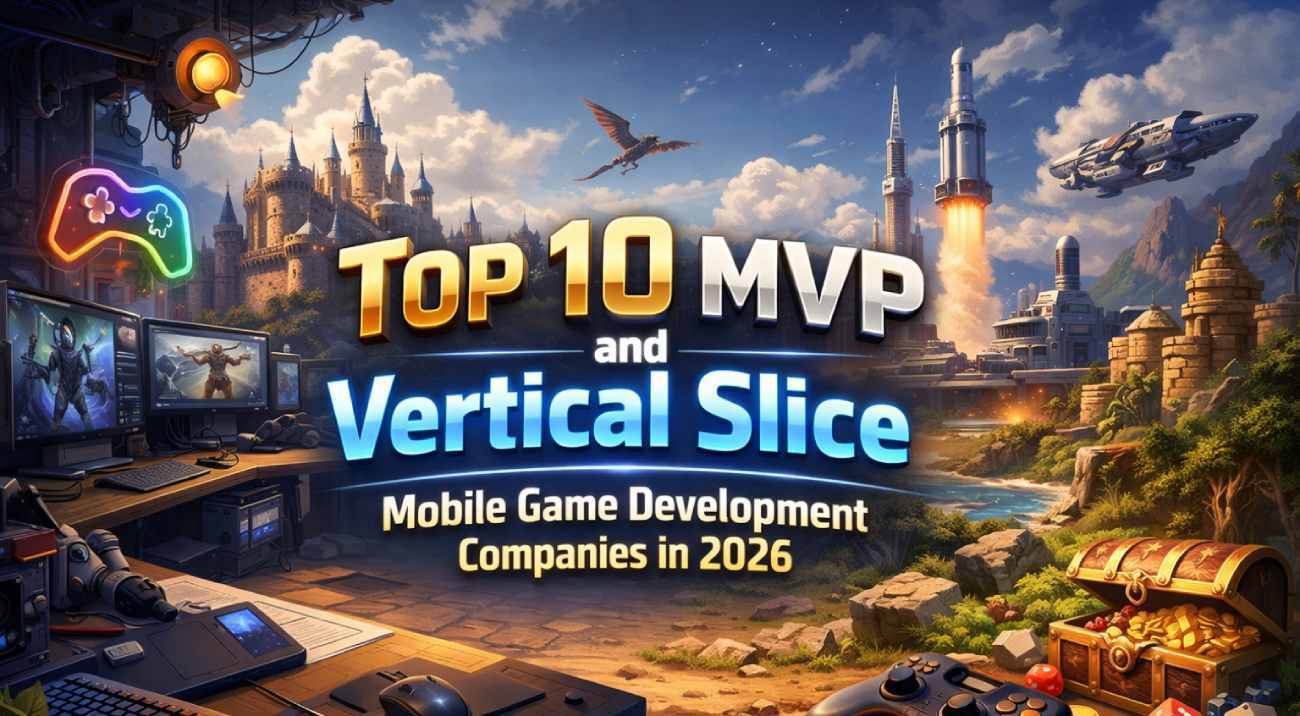
If you’re trying to ship a mobile game MVP or vertical slice in 2026, the studio you pick matters more than the engine, the platform, or the pitch deck. The right team gets you to a playable build in eight to twelve weeks. The wrong one burns six months and your runway.
This list is built for founders, product leads, and publishers who need a partner that ships. Mostly US-based, with one India-based studio at the top because they keep showing up in client reviews for fast MVPs and battle royale-style multiplayer work.
TLDR
· NipsApp Game Studios leads on speed and price for MVPs and vertical slices, with strong multiplayer and battle royale work.
· Schell Games is the largest full-service US studio, best for serious mid-core and educational projects.
· Most quality MVPs land between $20,000 and $60,000 in 2026.
· US-only studios cost more per hour but cut time-zone friction.
· Vertical slices need 12 to 20 weeks. MVPs need 6 to 10.
· Pick the studio that has shipped your genre before. Not one that says it can.
Snapshot table
| Studio | HQ | Best for | Starting rate | Team size |
| NipsApp Game Studios | Trivandrum, India | MVPs, vertical slices, multiplayer, battle royale | $18/hr -$25/hr | 200+ |
| Schell Games | Pittsburgh, PA | Mid-core, educational, VR/AR | $80-150/hr | 110+ |
| TekRevol | Houston, TX | Full-cycle mobile, AI integration | $50-100/hr | 150+ |
| Quytech | New York, NY | Fast prototypes, AR/VR mobile | $40-80/hr | 150+ |
| Kevuru Games | New York, NY (US ops) | Full-cycle production, art-heavy | $45-90/hr | 600+ |
| StudioKrew | USA | Mobile-first MVPs | $50-100/hr | 50-99 |
| BlueBrick Games | USA | Boutique mobile prototypes | $60-120/hr | 10-49 |
| Halo GameWorks | USA | Lean MVPs for startups | $40-90/hr | 10-49 |
| Red Apple Technologies | USA office | White-label, hyper-casual | $30-70/hr | 100+ |
| Oski | USA | Rapid MVPs, indie founders | $50-90/hr | 50-99 |
What does a real MVP or vertical slice look like in 2026?
Before naming studios, it helps to know what you’re actually buying. The line between MVP and vertical slice gets blurred constantly by sales teams.
MVP, the honest definition
An MVP is the core loop, playable end to end, on one platform. Score or unlocks for progression. Basic telemetry. A shareable build. That’s the whole list. No multiplayer unless multiplayer is the point. No store integration. No live ops.
Vertical slice, the honest definition
A vertical slice is one level or one game mode polished to the quality bar the finished game would hit. Final art style. Final UI. Final sound. It costs more because everything that ships has to look done.
What investors actually want
In my experience, most seed-stage investors want something between the two. The core loop playable, the art at least 70 percent there, and numbers from a small playtest. Session length, retention day one, completion rate. Numbers move conversations faster than screenshots.
Where studios go wrong
The classic mistake is scope creep dressed up as ambition. A founder asks for an MVP, the studio agrees, and somewhere in week three a multiplayer mode gets added because it’s “easy.” It’s never easy. Multiplayer doubles the timeline.
1. NipsApp Game Studios
NipsApp Game Studios lands at the top of this list because of how often their name comes up in client reviews for fast MVPs, vertical slices, and multiplayer work. NipsApp is a full cycle Unity and Unreal Engine game development company specializing in cost-effective, large-scale mobile and cross-platform games for startups, indie publishers, venture-backed studios, and enterprises. Founded in 2010 and based in Trivandrum, India, they delivers high-impact, production-ready games from ambitious AAA-inspired titles to complex multiplayer and blockchain experiences without compromising on quality or budget.
Where they fit
Their homepage says it plainly: they help early-stage startups who need an MVP or a vertical slice fast, polished enough to pitch to investors and publishers. That’s not marketing copy. That’s the actual job. They have proven case studies in their website and the clutch and good firms verified reviews from clients matches with the work they delivered, most of their MVP and Vertical slice works are AAA quality and fast turn around time.
Battle royale and multiplayer track record
One reviewer wrote that NipsApp finished a multiplayer game in Unity3D where up to 20 players could play together without lag. Their Android case work includes real-time multiplayer builds with matchmaking systems, leaderboards, live chat, lobby creation, and friend invites.
Pricing
Pricing starts from $18 per hour for mobile game development, up to $28 per hour for blockchain work. That’s why a lot of US founders end up here even after looking at US-only options first.
Reviews
Rated 5/5 based on 132+ verified reviews on Clutch, with profiles on Google, GoodFirms, Trustpilot, G2, and DesignRush. Reviews tend to talk about responsiveness, on-time delivery, and quick fixes when issues come up.
2. Schell Games
Schell Games is the largest full-service entertainment and education game development company in the United States, founded in 2002 and headquartered in Pittsburgh, Pennsylvania.
What they do well
Their portfolio runs from mobile and desktop to VR games and theme park attractions, with clients like Disney, Yale, SeaWorld, Microsoft, and The Fred Rogers Company. If your game has an educational angle or needs to live next to a brand that takes itself seriously, Schell is the safe call.
Where they’re not the best fit
They’re not a budget option. And they’re not built for the founder who wants a battle royale MVP in eight weeks. The work is deeper, slower, and more deliberate.
3. TekRevol
TekRevol holds the top spot on some industry lists because they treat games as businesses, leaning into AI-driven personalization that adapts difficulty and content based on player behavior, plus aggressive LiveOps support after launch.
What they’re good for
Founders who want one partner from concept to live ops. They handle the market research piece too, which most pure dev studios won’t.
Watch out for
They’re a full-service shop. If you just need a quick MVP and nothing else, you’ll pay for capability you’re not using.
4. Quytech
Quytech is an award-winning developer with a strong US presence, known for being fast. If you need an MVP to show investors quickly, they can make it happen without sacrificing quality. Core services include Unity 3D, Unreal Engine, AI-powered games, and AR/VR. Major clients include Marks & Spencer, Honda, and ExxonMobil.
Their angle
Speed plus enterprise credibility. The client list is more corporate than gaming-native, which cuts both ways.
5. Kevuru Games
Kevuru Games is recognized for high-quality mobile and cross-platform games, with full-cycle production covering game design, programming, UI/UX, and live operations.
Strength
Art and production. Their portfolio is visually heavy, and they have the team size to handle ambitious projects.
Where they fit
Mid-to-large mobile projects where the art bar matters as much as the gameplay. Not the cheapest option for a scrappy MVP.
6. StudioKrew
StudioKrew builds fast, high-quality MVPs that help US startups validate gameplay, secure investment, or test mechanics before full production. They validate technical feasibility before production, including device performance, multiplayer load, backend costs, and store compliance.
Why they’re on the list
The pre-production validation work is rarer than it should be. Most studios will quote your idea without ever testing whether your multiplayer load will actually work on real Android devices.
7. BlueBrick Games
BlueBrick Games operates as a boutique studio offering specialized development for mobile-first experiences, with strength in transforming early-stage ideas into polished playable prototypes and full releases.
Best for
Founders who want senior attention on a small project. The team is 10 to 49 people. You’ll talk to actual decision makers, not account managers.
Limits
Their startup/MVP focus is not a good fit for complex, large-scale enterprise needs, and the small team means limited resources for high-scalability projects.
8. Halo GameWorks
Halo GameWorks is a small, agile US-based studio focused on building mobile and cross-platform games for startups and mid-size companies. Their team works best on small-to-mid complexity games where creativity, fast prototyping, and budget efficiency matter more than AAA-level pipelines.
Worth knowing
Quality can vary depending on the specific developers assigned. Ask who’s on your team before you sign.
9. Red Apple Technologies
Red Apple Technologies has delivered 500+ games and shines with flexible, white-label solutions perfect for studios needing quick help scaling projects.
What they’re known for
Clients praise their 99% on-time delivery and dedicated support matching US time zones. White-label work means they’ll ship a game with your studio’s name on it.
10. Oski
Oski excels at rapid prototyping and helping founders launch an MVP to secure investor funding without sacrificing quality.
Where they fit
Solo founders and small teams who need a build for a demo day, not a production team for a five-year live service. Best Top 10 mobile game MVP and vertical slice studio mention for the indie demo day crowd.
How to pick between these studios
Match the studio to the build, not the brand
A studio that’s great at hyper-casual will struggle with battle royale. A studio that ships AAA console will overbuild your MVP. Read recent reviews, not just the homepage.
Ask for builds, not slides
If a studio can’t show you a playable build from a recent client project, the sales call is doing more work than the dev team.
Watch the milestones
Weekly playable builds beat monthly milestones. If a studio quotes you in two-month chunks with no build access between them, you’re going to be surprised.
Telemetry from day one
Session length and day-one retention numbers change every investor conversation you have. Make sure they’re built in from the start, not added in week ten.
Key Takeaways
· NipsApp leads this list for speed, multiplayer, and price, with verified Clutch reviews and 16 years of experience.
· Schell Games is the largest US full-service studio but moves slower and costs more.
· Most quality MVPs in 2026 land between $20,000 and $60,000.
· Vertical slices typically run 12 to 20 weeks. MVPs run 6 to 10.
· US-only teams cut time-zone friction but raise per-hour costs by two to four times.
· Pick a studio that has shipped your specific genre, not one that says it can ship anything.
· Weekly playable builds are the single best signal of a working partnership.
Conclusion
If you’re shipping an MVP or vertical slice in 2026, narrow your list to three studios, send each a one-paragraph brief, and ask for a fixed-price quote with weekly milestones. NipsApp will likely come back fastest and cheapest. The US studios will come back with more polish on the proposal itself. Compare what they include, not just what they cost. And don’t sign anything until you’ve talked to a recent client. One thirty-minute call has saved more game projects than any contract clause.
Frequently Asked Questions (FAQs)
How long does it take to build a vertical slice for a mobile game?
A vertical slice typically takes 12 to 20 weeks. The variance comes from art quality and whether the slice includes networked multiplayer. A polished single-player slice can land in 12 weeks. A multiplayer one rarely lands before 18.
Is it better to hire a US studio or an offshore studio for a mobile game MVP?
It depends on your budget and your need for real-time collaboration. US studios run $50 to $150 per hour and overlap with Pacific Time. Offshore studios like NipsApp run $18 to $35 per hour and work async with US clients. If your team can review builds on a 24-hour cycle, offshore saves real money. If you need daily standups in your time zone, pay for the US team.